GHK-Cu permeability
The promising cell biology meets a stubborn outer layer. The cream chemistry deserves equal billing with the cell biology.
The penetration experiment
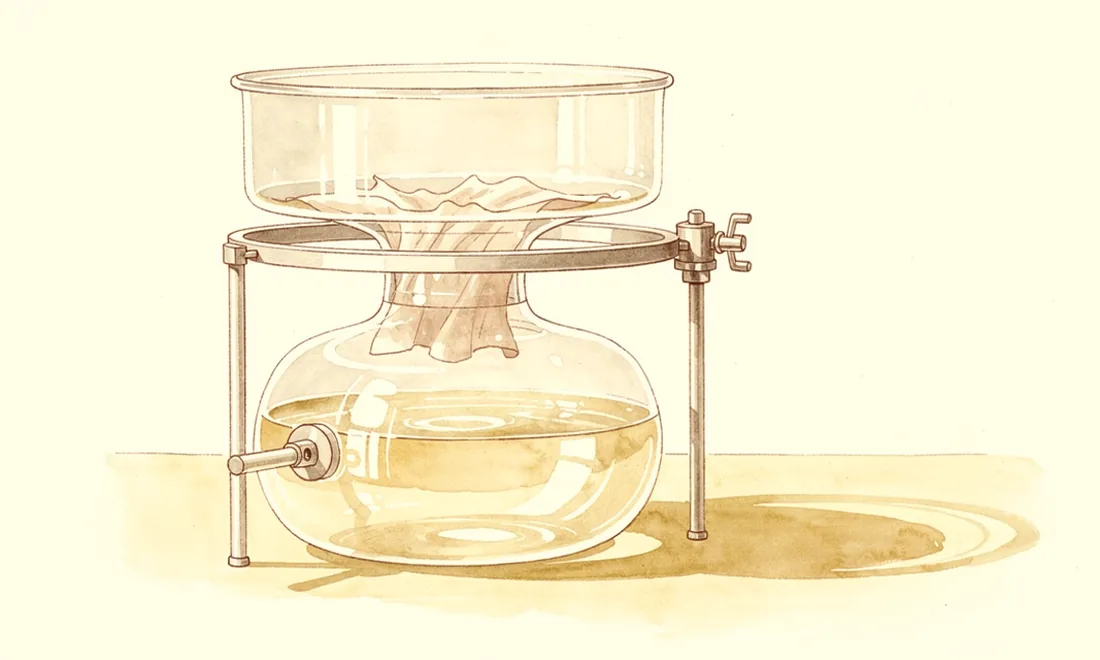
The apparatus separates a source of material from a receiving compartment, with skin between them. It gives the barrier a job we can measure. In the copper-tripeptide penetration study, researchers tested human skin outside the body and distinguished its layers. Copper appeared on the receiving side and accumulated within the skin itself.
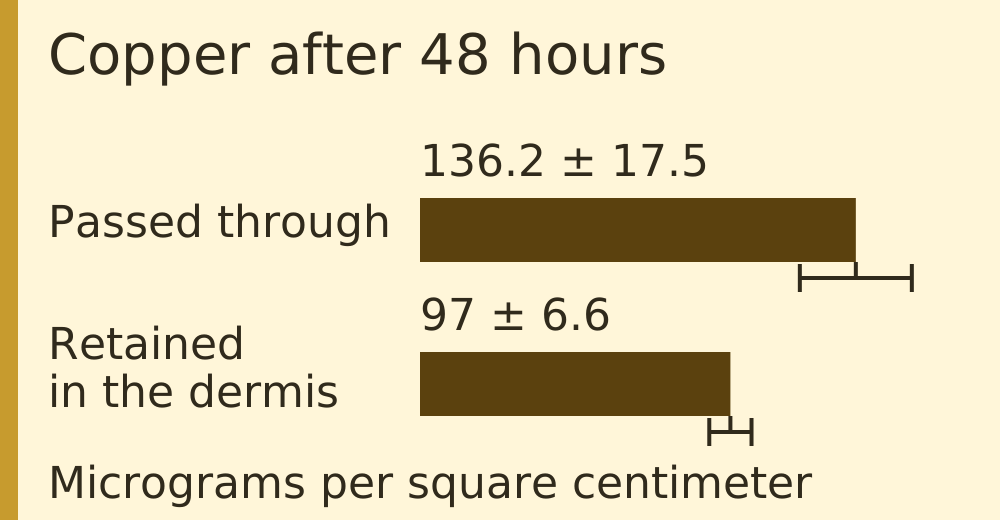
In dermatomed skin over 48 hours, the amounts were 136.2 ± 17.5 micrograms per square centimeter passing through and 97 ± 6.6 micrograms per square centimeter retained in the dermis. I picture both movements at once: material arriving on the receiving side while copper remains in the dermis. It complicates the simple journey from ingredient to destination.
The assay followed copper. Turning that measurement into a claim about intact GHK-Cu at a particular cell, or an improvement in wrinkles, would require further evidence. The preparation of the skin also matters: this laboratory result describes the tested specimen, rather than a forecast for every cream on intact skin.
Copper after 48 hours
The two amounts deserve to sit beside one another. A dermal depot describes copper remaining in the tissue after the experiment; the permeated amount describes copper that crossed it. Neither number measures a cosmetic result. Both come from the same isolated-skin study, with the uncertainty reported by its authors.
I’d put the copper reservoir at the centre of the next experiment. It also sharpens a question for later work: how much of any measured local effect depends on copper retained in the skin? The numbers alone cannot answer that.
Copper binding and formulation
GHK is a small peptide; GHK-Cu has copper attached to it. The topical-delivery review describes poor passage of free GHK through the stratum corneum, skin’s outer barrier, and surveys delivery approaches intended to change that. A formulation that helps a substance enter tissue has answered a different question from a trial showing a visible benefit.
Copper binding changes the chemistry. The same review discusses formulation stability, including the difficulty of combining the copper complex with reducing agents and low-pH ingredients. A longer list of possible benefits leaves me colder than those formulation details. They determine what material the skin actually encounters.
In reviews of skin regeneration, GHK-Cu stimulates collagen and other supporting material in laboratory models. The review reports increased collagen production in 70 percent of GHK-Cu-treated women, compared with 50 percent for vitamin C and 40 percent for retinoic acid. Those percentages concern collagen production; they give no percentage reduction in wrinkles.
The human hair trial
One result warrants a careful look at its ingredient list. A six-month trial in 45 men with male-pattern hair loss found greater hair-count increases with a mixture of GHK and 5-aminolevulinic acid than with placebo. No adverse events were reported in any group. The mixture contained GHK, and the study cannot separate its contribution from that of its companion ingredient.
That specific formulation produced a controlled human result. Assigning that credit to GHK-Cu alone would lose both the copper distinction and the combination design. This is a useful human finding precisely when its identity stays attached.
Gene expression
The gene-expression review gives the subject a much larger horizon, discussing cell and database findings involving repair, protein quality control and antioxidant pathways. Those pathways are an inviting puzzle to me; broad claims about reversing aging seem far ahead of the small topical human studies. A change in gene activity still needs to become a demonstrated benefit in a living person.
Community accounts of firmer skin, hydration, softer lines and fuller-looking hair are anecdotal accounts, not clinical evidence. Irritation, itching, dryness and unwanted pigment changes are reported too. Different formulations and other products in use make attribution difficult. Injectable accounts sit further from the human evidence, which is concentrated on topical preparations.
Topical Copper Tripeptide-1 is a legal cosmetic ingredient; GHK-Cu has no FDA-approved therapeutic indication. The cream literature establishes neither injectable effectiveness nor long-term systemic safety. The delivery literature leaves me with concrete experiments to look forward to: connecting local exposure to a defined skin outcome.