Melanotan II and pigment production
Here the skin makes more colour in response to a signal. The same compound also prompts responses elsewhere in the body.
Pigment cells
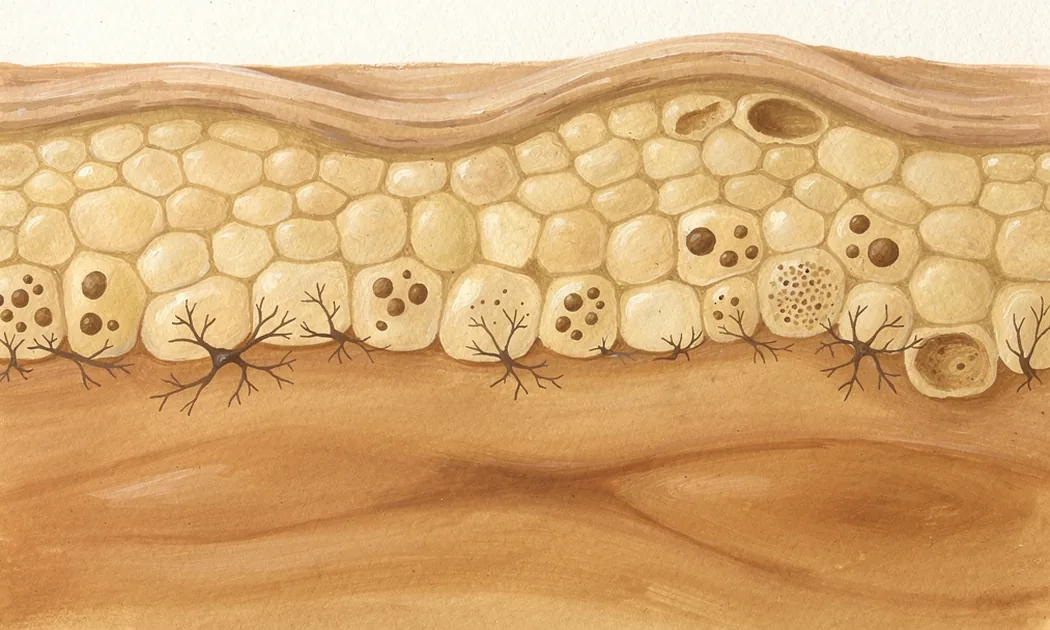
Melanotan II stimulates melanocortin receptors, proteins that receive the signal at a cell’s surface. In pigment cells, that signal increases the machinery for making melanin. The melanocortin history explains why this family attracted interest for pigmentation and why effects beyond skin became important.
I prefer the image of skin doing work to the image of a colour laid over it. It makes the biological ambition clearer. The synthetic compound was designed to imitate a natural pigment-stimulating hormone, with its amino acids closed into a ring to resist breakdown. That engineering also sits within a receptor system with roles in appetite and sexual function.
Pigmentation and erectile-function trials
The pilot pigmentation study involved three healthy men. Two developed darker skin on the face, upper body and buttocks after five treatments. Erections without sexual stimulation lasted one to five hours, and mild nausea was reported. The researchers had a visible pigmentation finding and other effects to account for in the same very small study.
A separate crossover study in ten men with psychogenic erectile dysfunction found clinically apparent erections in eight of ten men after Melanotan II. The mean duration above the study’s firmness threshold was 38.0 minutes with Melanotan II and 3.0 minutes with placebo. That measures time above the threshold, rather than the complete duration of each erection. Nausea, stretching and yawning were also recorded.
Those accompanying responses bother me. The pigmentation result offers little reassurance about safety. A wish to change skin colour gives no control over which other tissues respond. These studies were early investigations; Melanotan II has no approved human indication.
Food motivation in mice
In male mice given Melanotan II directly into the nucleus accumbens, a brain region involved in reward and motivation, the animals ate less and worked less to gain food. The experiment found neither conditioned taste aversion nor a change in metabolic rate. Its setting was exceptionally specific: direct delivery into a part of the mouse brain.
That precision interests me. It helps separate food motivation from a general story about feeling unwell, within this experiment. It also places a firm boundary around the conclusion. Human appetite reports cannot be treated as a replication of this procedure.
Clinical reports of harm
A report of renal infarction describes damage from loss of blood supply to part of a kidney. The authors judged Melanotan II the most likely cause and considered clotting effects or direct toxicity among the possible explanations. A case report cannot supply a risk percentage, but damage of that seriousness deserves space alongside the pigmentation trials.
Another report followed pigmentation of the gums and inner cheeks in one man. After he stopped using Melanotan II, inner-cheek colour began to fade by 28 days, while gum pigmentation remained at reduced intensity at three months. Even the retreat of the colour had different timings in different tissues.
A tan can be visible while less visible questions remain unresolved. The clinical reports deserve as much space here as the photographable effect. Long-term safety remains unknown, and changing moles and uncertain material quality add concerns to the limited controlled human evidence.
Online accounts
People describe deeper tans, nausea, flushing, reduced appetite, spontaneous erections and darkening of freckles or moles. Uneven colour and uneven fading appear in the accounts as well. These are anecdotal reports rather than clinical evidence, with uncertain contents and many possible influences on the changes described.
The analysis of melanotan marketing on social media examines the gap between online presentation and documented risk. I see a basic asymmetry there: colour is easy to display, while safety requires much longer and more demanding observation. The small human studies and case reports deserve to be read together. The comparison with GHK-Cu and GLOW returns to the different jobs skin is being asked to do.